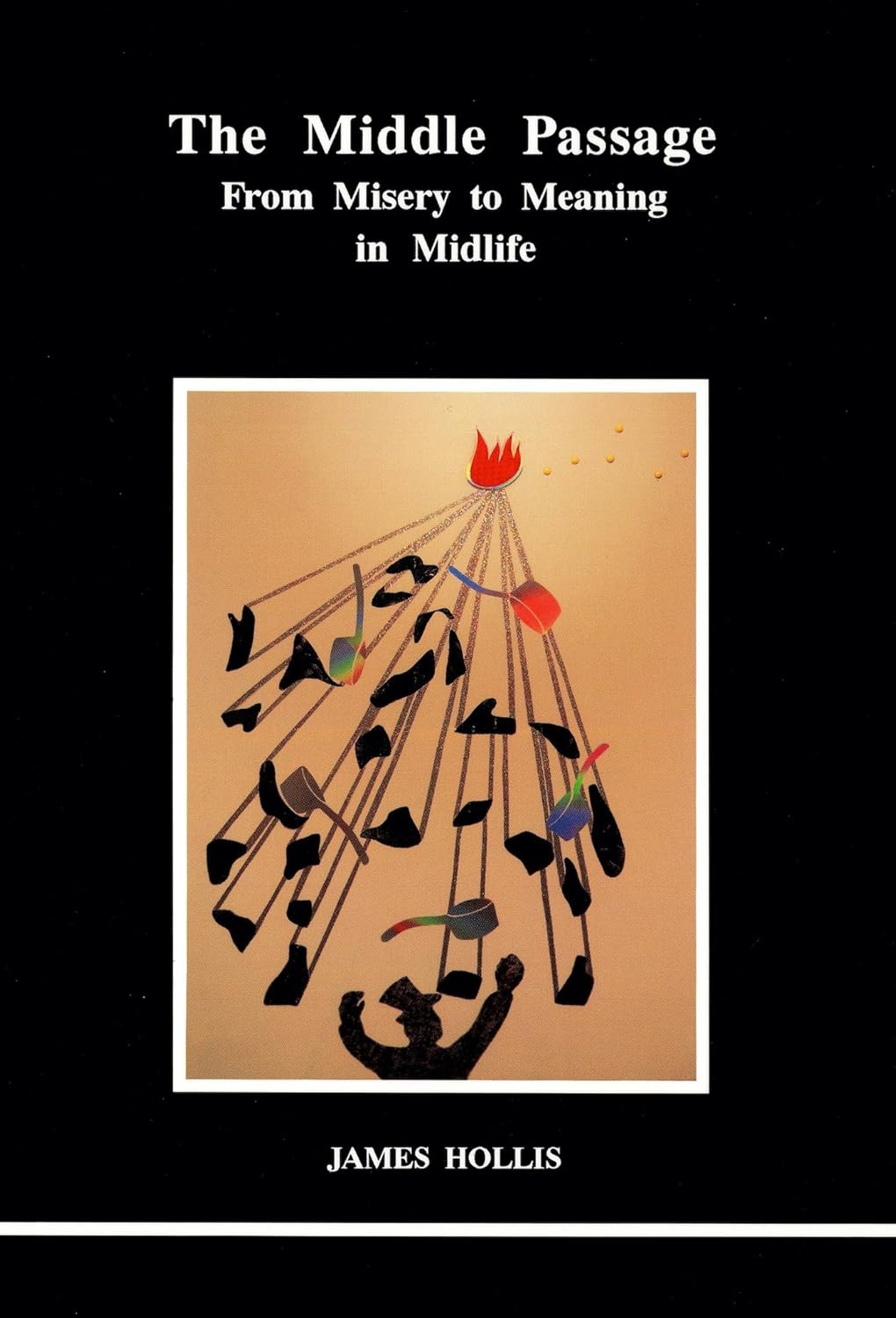
Some books find you at the place where the old answers have begun to fail.
The Middle Passage by James Hollis belongs on that shelf.
I am recommending it because it speaks with unusual depth to the season when the survival skills of the false self begin to lose their old power. The personality that helped you adapt, succeed, please, perform, endure, manage, and carry the life may begin to feel less like protection and more like a narrowing room.
That can feel frightening.
It can also be the beginning of a more honest life.
Why this book matters
Midlife is often misunderstood as a crisis of age, success, romance, work, or restlessness. Those may be part of it, but they are rarely the whole story.
At a deeper level, midlife can become an encounter with the unlived life. The roles that once gave structure start to feel too small. The ambitions that once carried energy lose their charge. The relationships that once held identity may reveal old bargains. The self that learned to survive begins asking whether survival should keep running the whole show.
That is why this book fits the Real Self journey.
Hollis writes into the psychological passage where old adaptations no longer protect meaning. The person may still be functioning, but something inward has begun to protest. The soul, to use Hollis's kind of language, begins making claims that efficiency cannot satisfy.
This is not a small moment.
It can feel like depression, restlessness, resentment, fatigue, grief, spiritual disorientation, marital loneliness, vocational doubt, or a strange sense that the life you built is no longer large enough for the self trying to emerge.
When the false self begins to fail
The false self often works well until it does not.
It helps you become acceptable. It helps you belong. It helps you not need too much. It helps you perform strength. It helps you stay useful. It helps you avoid anger, grief, longing, shame, dependency, and separateness.
But the very strategies that help you survive one chapter may become the limits of the next one.
The pleasing self may eventually feel resentful.
The high-performing self may become exhausted.
The independent self may become lonely.
The responsible self may become quietly furious.
The agreeable self may begin to disappear.
The impressive self may begin to feel hollow.
The Middle Passage is helpful because it does not treat this breakdown as mere pathology. It understands that something meaningful may be trying to happen inside the disruption.
That does not make the disruption easy.
It means the pain may be carrying information.
How to read it
Read this book slowly.
Do not read it as a project to master. Do not turn it into another assignment for the false self, another way to become deep, wise, spiritual, or psychologically impressive.
Let it question you.
Notice what stings. Notice what irritates you. Notice what you want to underline and what you want to avoid. The avoided sentence may have a candle in it.
You might read a few pages and then ask: what part of my life still belongs to an old agreement? What did I choose because I had to survive? What now wants to be chosen because it is true?
Those are not comfortable questions.
Comfort is not always the point. Sometimes the point is honesty with enough mercy in it that you can bear the truth.
Three doorways to notice
The unlived life. Pay attention to the longings, griefs, and possibilities that did not disappear simply because you adapted around them.
The old bargain. Notice where you traded aliveness for approval, safety, success, certainty, or belonging.
The summons beneath the crisis. Ask what deeper life may be calling from inside the disruption, not as fantasy, but as a more truthful form of responsibility.
When this book may help
This book may be useful if you are in midlife, approaching midlife, or living through a season that feels like the collapse of old certainties.
It may also help if you are not in midlife chronologically but are in a middle passage psychologically. That can happen whenever the old identity no longer holds and the new one has not yet become clear.
This is often the space between the false self and the Real Self.
Not the dramatic cinematic version.
The real version: confusing, humbling, uneven, and full of grief.
But also full of possibility.
Because when the old survival structure begins to fail, it may not mean your life is falling apart.
It may mean the life that is actually yours is beginning to ask for you.
Questions to Consider
- Which old survival skill has begun to feel too small for the life you are now being asked to live?
- Where might disappointment, fatigue, or restlessness be carrying an honest message?
- What part of your unlived life keeps returning, even quietly?
A Small Practice
After reading, write one sentence that begins: “The old bargain was...” Then write one sentence that begins: “The truer life may be asking...” Do not force an answer. Let the sentences remain unfinished if they need to.
Clinical note: This reading feature is educational and reflective. It is not a diagnosis, crisis care, or a substitute for psychotherapy, medical care, or individualized professional support.